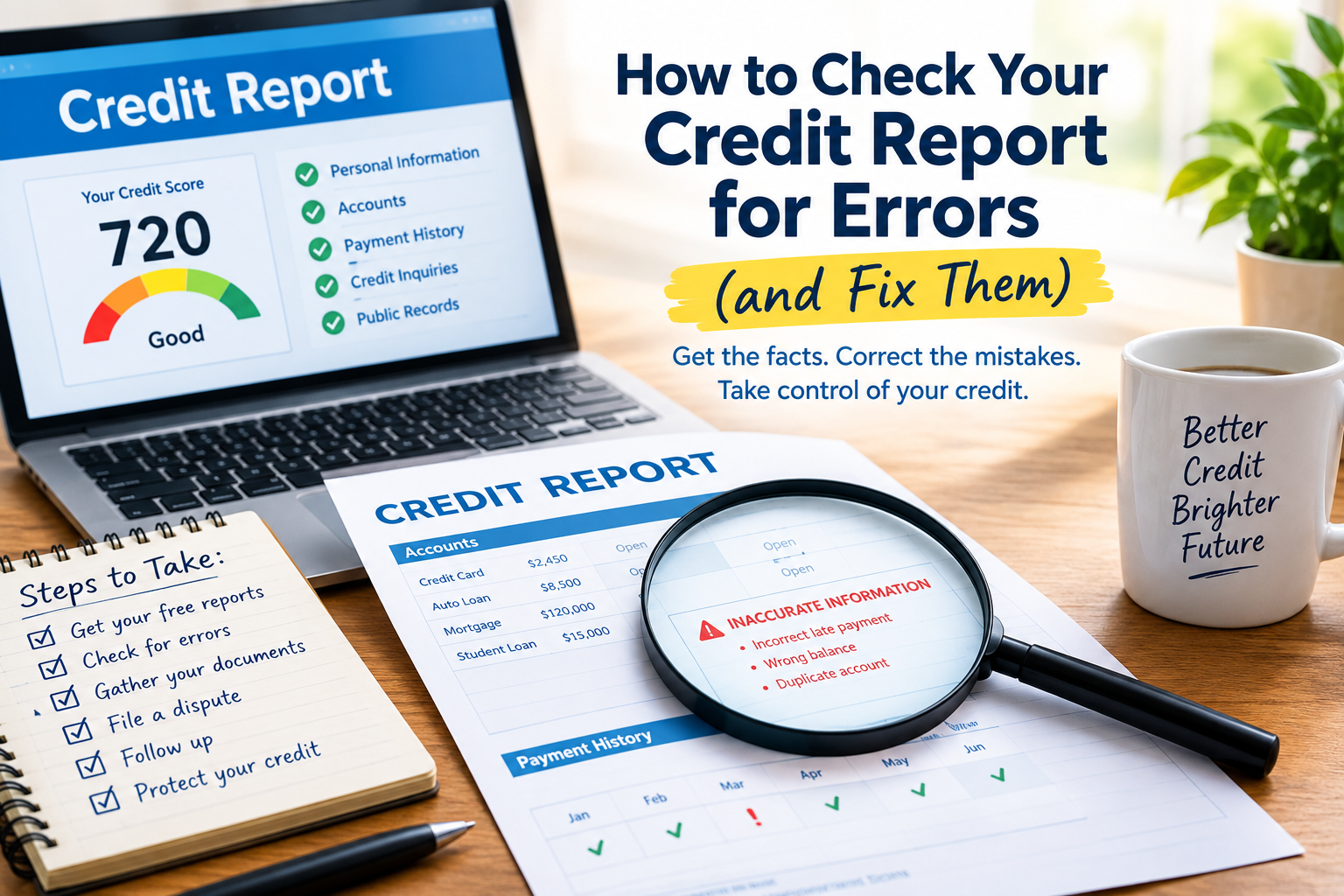
Your credit report can influence your ability to qualify for credit cards, loans, and other financial products. But what happens when the information on your report is wrong?
An incorrect late payment, an account you never opened, or a balance that does not belong to you could create unnecessary problems when you apply for credit.
The good news is that you have the right to dispute inaccurate or incomplete information on your credit reports. Checking your reports regularly can help you identify mistakes, protect yourself from identity theft, and take control of your financial future.
In this guide, you will learn how to check your credit report for errors, where to get free copies, what mistakes to look for, and how to dispute incorrect information step by step.
Where Can You Get Your Free Credit Reports?
The first step is to get copies of your credit reports from the three major nationwide credit reporting companies:
- Equifax
- Experian
- TransUnion
You can request your reports through AnnualCreditReport.com, the federally authorized website for free credit reports from these companies.
You can also learn more about your rights through the Consumer Financial Protection Bureau (CFPB).
Important: Requesting your credit report is different from applying for a loan or credit card. Checking your own credit report does not hurt your credit score.
It is worth reviewing all three reports because the information they contain may differ. A mistake could appear on one report but not the others.
You do not need to pay for a credit monitoring service just to obtain your reports through the official website.
7 Common Errors to Look for on Your Credit Report
Once you have your reports, review them carefully. Do not assume that every account, balance, or payment status is correct.
Here are seven types of errors to look for.
1. Incorrect Personal Information
Start with your basic information.
Check your name, address, phone number, and other identifying details for mistakes. An incorrect address alone does not necessarily damage your credit score, but identity errors can sometimes indicate that information belonging to another person has been mixed into your file.
Pay particular attention to accounts that do not appear to belong to you.
2. Late Payments That Were Reported Incorrectly
Because payment history is an important factor in many credit scoring models, this is one of the most important areas to review.
Look for accounts marked late when you believe you paid on time. Check the payment dates, account history, and reported delinquency status.
For example, imagine you paid your credit card bill before the due date, but your credit report shows that payment as 30 days late.
If your payment records support your claim, you can dispute the inaccurate information with the credit reporting company and the card issuer.
However, if the late payment really happened, it generally cannot be removed simply because it is hurting your score. Accurate negative information is not automatically an error.
3. Accounts You Do Not Recognize
Review every credit card, loan, and other account listed on your reports.
If you find an account you never opened, do not ignore it. It could be a reporting mix-up, an account opened fraudulently, or a result of identity theft.
Contact the company associated with the account and the credit reporting company. If you suspect identity theft, visit IdentityTheft.gov for guidance on reporting it and protecting yourself.
Do not assume that an unfamiliar account is automatically fraudulent. First, check whether it could be an account you opened under a different lender name or an account on which you are an authorized user.
4. Incorrect Account Balances or Credit Limits
Compare the balances and credit limits on your reports with your recent account statements.
Look for balances that appear inaccurate, payments that have not been reflected properly, or credit limits that do not match your records.
Incorrect balances or limits can affect how your credit utilization is calculated, which may influence your credit score.
If you identify a discrepancy, gather your latest statements and payment confirmations before filing a dispute.
5. Closed Accounts Listed as Open
If you closed a credit card or paid off a loan, check how the account is reported.
An account that should be marked closed but appears open may be an error. Similarly, check whether an account is incorrectly listed as delinquent or carrying an outstanding balance.
Keep in mind that a closed account can legitimately remain on your credit report. Its presence alone does not mean something is wrong.
6. The Same Debt Listed More Than Once
Sometimes, a debt may appear more than once because of a reporting error or confusing account information.
Compare the account details, creditor names, balances, and dates before deciding that duplicate entries exist.
Debt transfers and collection activity can sometimes result in different companies reporting related information, so do not automatically assume that every similar entry is a duplicate debt.
If you believe the same obligation has been incorrectly reported more than once, dispute the specific entries and explain why you believe they are inaccurate.
7. Incorrect Dates or Account Statuses
Review the dates associated with your accounts, including the opening date, payment history, and delinquency information.
An incorrect date or account status could make your credit history appear different from what actually happened.
If you find a discrepancy, compare the report with your original account statements, lender correspondence, or other records.
The CFPB provides additional guidance on common credit report errors.
How to Dispute Credit Report Errors Step by Step
Finding a mistake is only the beginning. The next step is to challenge the inaccurate information and keep records of your efforts.
Step 1: Identify the Exact Error
Write down the account name, the information you believe is wrong, and where it appears on your credit report.
Be specific.
For example, instead of saying, “My credit report is inaccurate,” explain that a particular credit card payment is reported as 30 days late even though your payment confirmation shows it was made before the due date.
A clear explanation makes it easier for the company to understand what needs to be investigated.
Step 2: Gather Supporting Documents
Collect documents that help establish what actually happened.
Depending on the error, these may include:
- Bank statements showing a payment was made.
- Credit card statements showing the correct balance.
- Payment confirmations or receipts.
- A letter from the lender acknowledging an error.
- Documents showing that an account was closed.
- Records supporting a claim of identity theft.
Send copies rather than original documents, and keep your own copies of everything.
You do not need to have every possible document before starting, but relevant evidence can help explain your dispute.
Step 3: Contact the Credit Reporting Company
Submit a dispute to the company whose report contains the inaccurate information.
You can generally file disputes online or by mail. Follow the instructions provided by the reporting company and explain what is wrong, why it is wrong, and what correction you are requesting.
You can find the official dispute pages here:
If you prefer mailing your dispute, use the current address and instructions supplied by the relevant company. Consider using certified mail with a return receipt so you have a record of delivery.
Step 4: Contact the Company That Reported the Information
You should also consider disputing the error directly with the lender, credit card issuer, collection agency, or other company that supplied the information.
This company is often called the information furnisher.
For example, if your bank incorrectly reported a late payment, contact the bank’s department responsible for credit reporting disputes.
Explain the error, provide supporting documents, and request that the company investigate and correct any inaccurate information it reported.
The CFPB explains both parts of the process in its guide: How to dispute an error on your credit report.
Step 5: Wait for the Investigation Results
Credit reporting companies generally have 30 days to investigate a dispute, although certain circumstances can extend the investigation period.
The company should communicate the results to you. If the investigation determines that the information is inaccurate or cannot be verified, the information generally must be corrected or removed as required by law.
If the information is found to be accurate, it may remain on your report.
Remember that filing a dispute does not guarantee that an entry will be removed or that your credit score will increase. The outcome depends on the facts and the investigation.
Step 6: Review Your Updated Credit Report
After the investigation, check your report again to confirm whether the correction was made.
If an error appears on more than one credit report, check each affected report. Correcting information with one credit reporting company does not mean you should assume every other report has been updated.
If the mistake remains unresolved, review the investigation results, provide additional evidence where appropriate, and consider submitting a complaint to the CFPB.
You can also consult the Federal Trade Commission’s guide to disputing credit report errors.
What If Your Credit Report Contains a Genuine Late Payment?
This is an important distinction.
If you really missed a payment, disputing the entry will not normally remove it when the information is accurate and properly reported.
Instead, focus on what you can control:
- Bring overdue accounts current when possible.
- Contact your lender if you need help understanding your options.
- Set up payment reminders or automatic payments where appropriate.
- Avoid taking on new debt you cannot comfortably manage.
- Check your reports periodically to ensure future information is accurate.
If you believe the late payment was caused by a reporting mistake or another legitimate issue, gather the relevant evidence and explain your situation to the company.
For more practical guidance, read our related article: How to Rebuild Your Credit Score After Late Payments.
How Often Should You Check Your Credit Reports?
Checking your credit reports regularly helps you stay aware of changes and catch possible mistakes sooner.
Consider reviewing your reports:
- At least annually.
- Before applying for a major loan, such as a mortgage or auto loan.
- After discovering possible identity theft.
- After a dispute that resulted in a correction.
- Whenever you have a reason to suspect inaccurate information.
You do not have to wait until you are applying for credit to review your reports. Making it part of your regular financial routine can help you stay informed.
A Simple Credit Report Review Checklist
Use this checklist when reviewing your reports.
- Confirm that your personal information is correct.
- Check that every account belongs to you.
- Review payment history for incorrectly reported late payments.
- Compare account balances and credit limits with your statements.
- Check whether closed accounts have the correct status.
- Look for duplicate or unfamiliar debt entries.
- Review account dates and delinquency information.
- Gather evidence for any errors you identify.
- File disputes with the appropriate companies.
- Review your reports again after the investigation.
You do not need to fix everything in one sitting. Work through the list carefully and keep a record of what you find.
Frequently Asked Questions
Does checking my credit report lower my credit score?
No. Checking your own credit report is considered a soft inquiry and does not lower your credit score.
How can I get my credit report for free?
Visit AnnualCreditReport.com to request free reports from Equifax, Experian, and TransUnion. Avoid unfamiliar websites that advertise free reports but require unnecessary subscriptions or paid services.
Can I dispute a late payment on my credit report?
Yes, if you believe the late payment is inaccurate or incomplete. Provide a clear explanation and supporting documents. If the late payment is accurate, it generally cannot be removed simply because you dispute it.
How long does a credit report dispute take?
Credit reporting companies generally investigate disputes within 30 days, although some cases can take longer under applicable rules. Keep track of when you submitted your dispute and review the results when they arrive.
Will removing an error improve my credit score?
It may, depending on the error and the credit scoring model used. For example, correcting an inaccurately reported late payment could help, but no particular score increase is guaranteed.
What should I do if I find an account I never opened?
Contact the credit reporting company and the company associated with the account. If you suspect fraud or identity theft, visit IdentityTheft.gov for official guidance.
Final Thoughts: Take Control of Your Credit Report
Your credit report is an important part of your financial life, but you do not have to accept inaccurate information without taking action.
Start by getting your reports, reviewing the details, and identifying anything that does not look right. If you find an error, gather your evidence, submit a clear dispute, and follow up on the results.
If your credit history also includes genuine late payments, remember that correcting reporting errors and rebuilding credit are two different tasks. Both can be important steps toward better financial health.
You may not be able to change every part of your credit history overnight, but you can take practical steps to make sure the information being reported about you is as accurate as possible.
A stronger financial future starts with understanding where you stand and taking the next right step.
Disclaimer: This article is for educational purposes only and is not financial, legal, or credit-repair advice. Credit reporting rules and individual circumstances can vary. Consult official resources or a qualified professional for guidance specific to your situation.