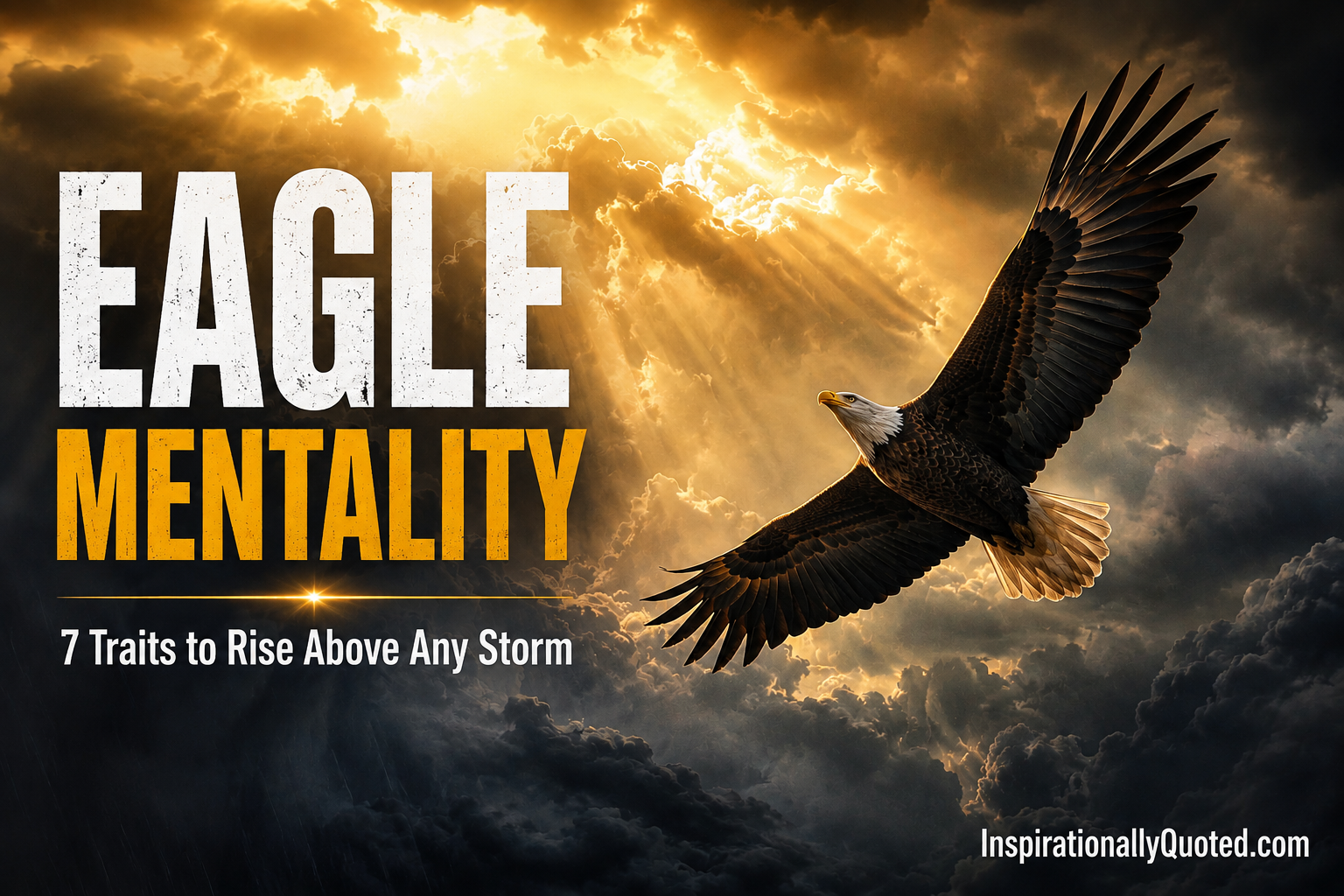
There’s a reason eagle mentality shows up in scripture, in leadership seminars, and on a hundred motivational posters. It isn’t just a bird with good eyesight. It’s one of the only creatures on earth that, when a storm rolls in, doesn’t run from it — it uses it. An eagle will fly into a storm and let the wind lift it above the clouds, while every other bird scrambles for cover.
So what does eagle mentality actually mean? At its core, it’s not about being fearless. It’s about how you respond when the pressure hits — and whether you let it ground you or lift you.
Here are seven traits that define an eagle mentality, and how to actually build them into your daily life.
1. Eagles Fly Alone (and With Their Own Kind)
Eagles don’t flock. You won’t see a hundred eagles crowding one branch the way pigeons or starlings do. They fly solo, or with one or two others at their level.
This isn’t about isolating yourself. It’s about being intentional with your circle. An eagle mentality means you stop shrinking yourself to stay comfortable in a crowd that isn’t going anywhere, and you get selective about who has real influence over your thinking.
How to apply it: Audit your five closest relationships. Are they pulling you up or holding you at their altitude? You don’t have to cut people off — but you can be honest about who you let speak into your decisions.
2. Eagles Have Vision That Sees What Others Miss
An eagle can spot prey from two miles away. That kind of vision doesn’t happen by accident — it’s built for looking far ahead, not just at what’s directly in front of it.
People with an eagle mentality do the same thing with their lives. They’re not just reacting to today’s inbox or this week’s crisis. They have a sense of where they’re headed, even when the immediate view is foggy.
How to apply it: Ask yourself where you want to be in five years, then work backward. What does this week’s decision look like from that distance?
3. Eagles Fly Into the Storm
This is the signature eagle move. When bad weather approaches, most birds find a tree and wait it out. An eagle spreads its wings and uses the storm’s own updraft to climb above it, resting on the very wind that would have grounded anything else.
Your storms — job loss, a broken relationship, a diagnosis, a failure you didn’t see coming — are not signs to hide. They’re often the exact conditions that lift you somewhere you couldn’t have reached on a calm day.
How to apply it: Next time you’re in a hard season, ask “What is this teaching me that comfort never could?” instead of only asking “When will this end?”
4. Eagles Test Before They Trust
There’s an old (if debated) bit of eagle folklore worth keeping anyway: before an eagle lands on a branch, it will test it — a light landing, a shift of weight — to see if it holds. It doesn’t fully commit until it knows the branch can carry it.
Translate that to people and opportunities. An eagle mentality doesn’t mean being cynical or closed off. It means you don’t hand over your full trust — your time, your secrets, your energy — to something untested.
How to apply it: With new relationships or opportunities, give it time before going all-in. Watch how someone treats you in a small moment before trusting them with a big one.
5. Eagles Have Sharp, Uncomfortable Self-Correction
An eagle can live 70+ years, but around age 40, its beak grows too curved to hunt, its talons lose their grip, and its feathers grow thick and heavy. According to the popular version of the story, the eagle then goes through a painful process: it plucks out its own feathers and knocks its beak against a rock until it breaks off, growing back sharper.
Whether or not that’s biologically precise, the lesson holds: growth is rarely gentle. Sometimes rising above your current situation means deliberately breaking something in yourself that isn’t serving you anymore — a habit, an old identity, a way of thinking that used to protect you and now just limits you.
How to apply it: Name one habit or belief you’ve outgrown. What would it look like to deliberately “molt” it this month instead of dragging it forward?
6. Eagles Don’t Compete With Crows
Crows will mob an eagle — dive-bombing it, screeching, trying to provoke a fight. An eagle almost never engages. It simply climbs higher, into thinner air where the crow can’t follow, and lets the noise fall behind.
This is maybe the single most practical trait. Not every critic deserves your altitude. An eagle mentality means recognizing when something is beneath your engagement and choosing to rise instead of react.
How to apply it: Next time someone tries to provoke you — online, at work, in your family — ask: “Is this worth descending for, or do I just keep climbing?”
7. Eagles Trust Their Wings, Not the Ground
An eagle’s power comes from the air, not the earth. It doesn’t scavenge on the ground the way vultures do; it’s built to catch the wind under its wings and let that carry the weight.
The equivalent for you is trusting the process, the faith, the skill you’ve built — even when you can’t see solid ground beneath you. Uncertainty is uncomfortable, but it’s also exactly the condition an eagle is built for.
How to apply it: When you’re in a season without clear answers, focus on what you can control (your effort, your attitude, your next right step) rather than demanding certainty before you’ll move.
The Takeaway
An eagle mentality isn’t a personality type you’re born with — it’s a set of choices you make under pressure. Fly with the right people. Keep your eyes on the horizon, not just the storm. Let hard seasons lift you instead of grounding you. Test before you trust. Be willing to shed what no longer serves you. Don’t waste your altitude on every crow that screeches at you. And trust your wings even when the ground disappears.
You don’t need perfect conditions to rise. You need the willingness to spread your wings when the storm comes — because that’s exactly when eagles fly highest.
Which of these seven traits do you need to work on most right now? Let us know in the comments.